

Learning Designer
May. 2024 - June. 2024
Articulate Storyline, Vyond, Google Doc
I came across the Elearning Designer Academy led by Tim Slade from LinkedIn. He guided the monthly learning challenge for people to put their instructional design and development skills into practice. The topic of foodborne illness prevention is the challenge in June.
Tacomazing Cantina runs several popular brick-and-mortar restaurants serving authentic Mexican street tacos. The owners plan to take popular tacos on the road to festivals via new food trucks. This secondary revenue stream will provide Tacomazing with an avenue to increase sales, introduce its food to new customers, and represent the business in local communities. Management wants to ensure the food trucks pass the health inspections with flying colors, but food trucks pose unique challenges to restauranteurs due to several factors. Because food will be transported from restaurants to trucks and prepared and kept hot and/or cold in the trucks’ kitchens, staff must be upskilled on the risks and prevention of foodborne illness in this new environment.
After completing your course, learners should be able to complete one or more of the following objectives:
1. Determine the proper temperature at which raw and cooked foods should be stored.
2. Check the temperature of various foods and interpret the temperature using safe handling guidelines.
3. Identify cross-contamination risks in the food truck kitchen and determine prevention strategies, such as not reusing cutting boards or knives.
4. Implement proper hand hygiene practices such as washing hands, wearing gloves, and changing gloves when preparing and serving food in the truck.
Since the problem and needs are provided, my focus is mainly on the design part. The process starts with grasping the relevant knowledge, making text-based storyboards, creating animations with Vyond, and ends with adding interactions with Articulate Storyline.
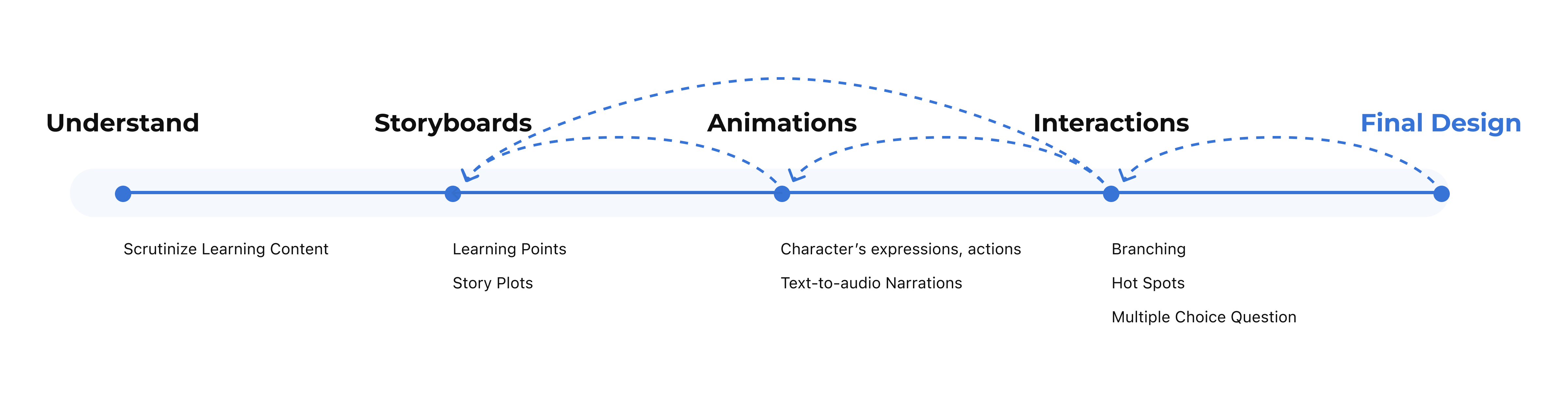
To design lessons that reach the objectives, I have to read through the provided material to learn more about the relationship between food trucks and food safety, restaurant safety, and safe food handling.
Once I had a general idea of foodborne illness prevention, I began working on text-based storyboards that incorporated a few key learning points.
I framed the scenario as a head chef guiding his team to prepare the ingredients, cooling them down, and loading them on the truck. The sequence matched the real-life scenario. Some interactive moments are contemplated such as branching scenarios, clicking all the items before continuing the scene, and a multiple-choice question.


Animations help visualize stories the best. I broke down each scene and made them with Vyond. It showed the action, expression, and interaction between the characters with backgrounds in the kitchen or food truck. Also, I used the text-to-audio feature to generate voiceovers for my characters. They make the story vivid to engage learners.

Once the animations were settled, I created hop spots, branching, and more interactions. They were to encourage users to finish all content in the scene before moving on. Also, different stories would result from their decisions.
I used Vyond and Articulate Storyline to create an interactive prototype to reach the learning objectives. Here are some special features I’d like to further walkthrough.


The monthly challenge has a style guide to follow but I didn’t follow it. Here are some branding opportunities that I miss. The colors for the question boxes and the star circle for the A rating were places where I could incorporate TacoMazing branding.
Vyond is an interesting animation-creating tool that provides various features and is easy to get used to. One cool feature allows users to change characters’ expressions and actions. Another one is the text-to-audio voiceovers, which are not just voices but vocal emotions to choose from. All these make the video engaging and vivid.


